



Bill 41 and Bill 16: how to prepare your buildings for 2026
With the coming into force of Bill 41 (energy performance) and the application of the Bill 16 regulation (maintenance log + contingency fund), 2026 will become a pivotal year for building managers, operations directors, and property owners in Québec.
Both laws are progressing in parallel: one governs energy performance, the other building governance and maintenance. Together, they define the new standard for managing Québec’s built assets.
To help you anticipate your obligations and plan your strategy, here is a clear overview based on official Québec sources and the analysis of Dzmitry Puzyryn, Director of Energy Efficiency at BAULNE.
What are Bill 41 and Bill 16?
Bill 41 — energy performance of buildings
According to Publications du Québec, Bill 41, adopted in March 2024, “imposes minimum environmental performance standards on buildings” and aims to reduce GHG emissions and energy consumption.
“Bill 41 on building performance is already in force. By 2029, buildings will have to reach a first performance level, and by around 2030, requirements will be even higher. Managers must start preparing now to meet these targets.”
— Dzmitry Puzyryn, BAULNE
The Ministry of the Environment specifies, in documentation presented to the Fédération québécoise des municipalités, that the law will establish a mandatory framework for energy reporting, rating, and monitoring of buildings. The National Assembly confirms that the Minister may require the transmission of energy data to establish a provincial overview.
According to a technical notice published by Contenu Québec and reinforced by an analysis from the APCHQ, existing buildings may potentially be required to carry out:
- energy audits,
- professional inspections,
- upgrade work (HVAC, insulation, heating, ventilation, controls).
In a brief, the Ordre des ingénieurs du Québec notes that the exact thresholds, building categories, and timelines will be defined in the implementing regulations, which requires preparing now.
Bill 16 — maintenance log and contingency fund
According to the Government of Québec, since August 14, 2025, Bill 16 requires all divided co-ownerships to have:
- a maintenance log,
- a compliant contingency fund study.
These requirements are now mandatory for all condominium syndicates. For a visual summary of the changes, see here ( in French only):
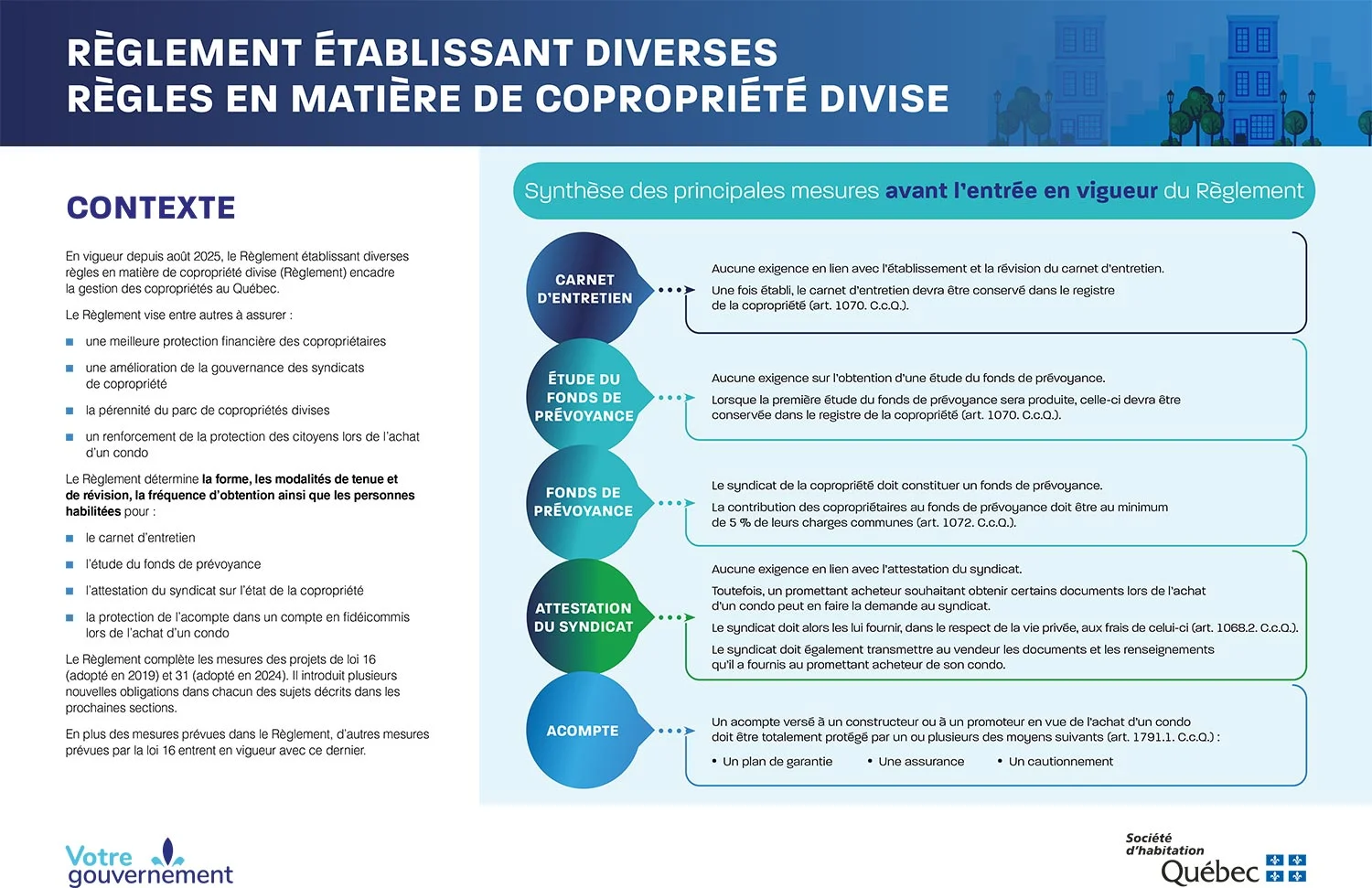
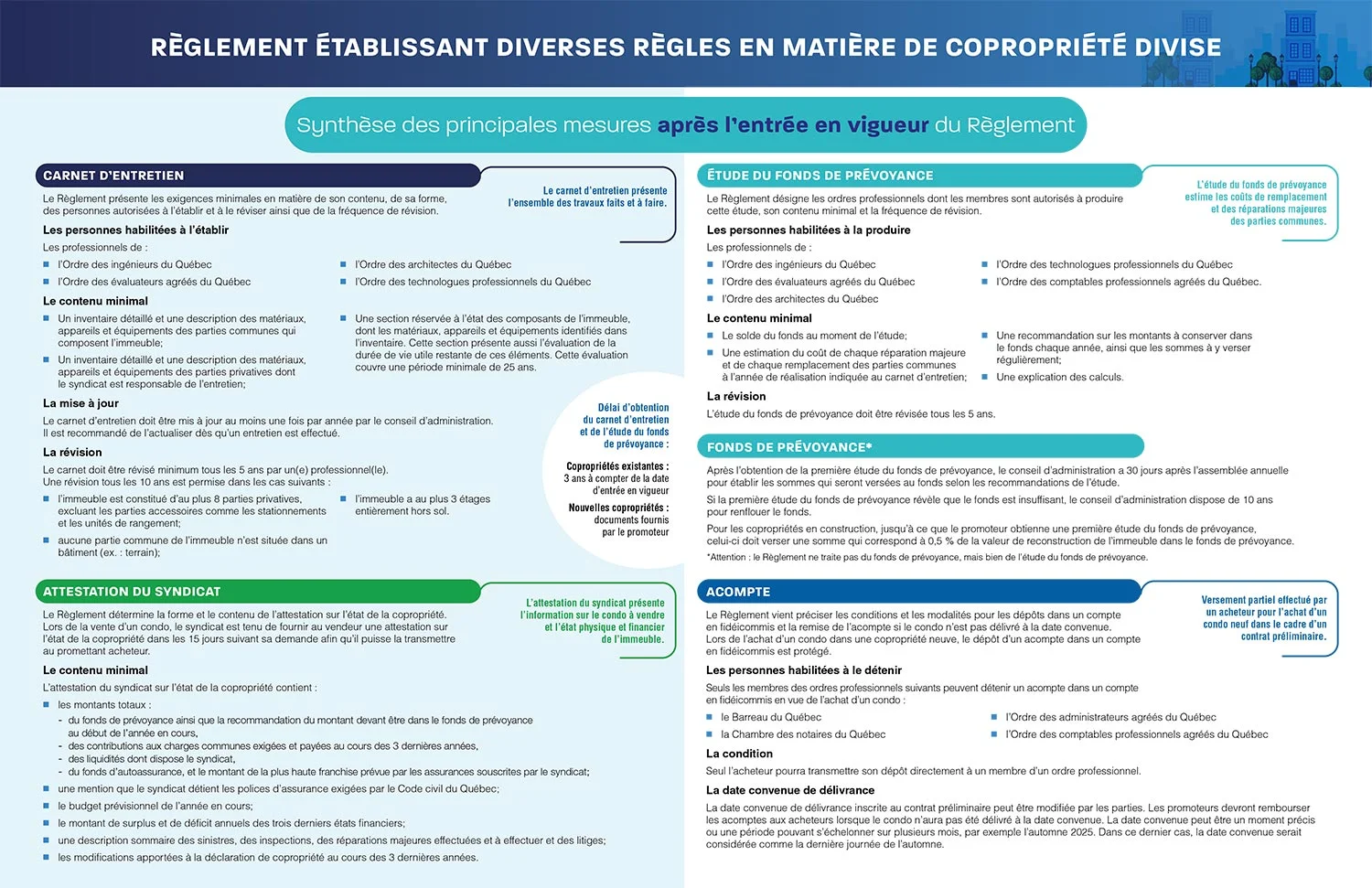
According to the Government of Québec, the new regulation imposes four major obligations on divided co-ownerships:
Mandatory maintenance log
Each co-ownership must maintain a maintenance log produced by a professional and update it regularly to ensure proper planning of work.
Contingency fund study
A professionally conducted fund study must anticipate major repairs and be reviewed every five years.
Syndicate certificate upon sale
When a unit is sold, a certificate from the syndicate must be provided to the buyer to present the condition of the building, its financial situation, and the insurance coverage in force.
Protection of deposits
Deposits paid for the purchase of new units may be placed in a trust account administered by an authorized professional, offering enhanced protection for buyers.
Why are Bill 41 and Bill 16 complementary?
“We must now bring these laws together and propose a comprehensive energy transition vision: maintenance logs, contingency funds, decarbonization, and optimization of operating costs.”
— Dzmitry Puzyryn, BAULNE
| Aspect | Bill 41 | Bill 16 |
| Objective | Reduce energy consumption and GHGs | Ensure maintenance, foresight, and transparency |
| Obligation | Audits, energy monitoring, work | Maintenance log, fund study |
| Scope | Environmental performance | Financial and asset management |
| Impact | Operating costs and efficiency | Building durability and long-term value |
Managers must now manage performance + foresight + compliance within a single, global vision.
What should you do in 2026 to better comply with both laws?
- Plan a comprehensive energy audit that will provide a clear picture of the current condition of mechanical systems and modernization pathways (investment, profitability, return on investment, post-upgrade building energy performance) in order to comply with legal requirements and optimize spending.
- Create or update the mandatory maintenance log (Bill 16). Include HVAC equipment, failure history, replacements, maintenance records, etc.
- Launch or revise the contingency fund study.
- Plan system decarbonization and modernization.
- Establish a 2026–2030 investment plan.
- Aligned with both laws.
- Plan over 25 years and quantify future investments. Integrate energy optimization and modernization measures based on the energy audit results and Bill 41 requirements, while taking into account the remaining useful life of assets (according to the contingency fund study — Bill 16).
- High-efficiency HVAC solutions, intelligent controls, building automation, heat recovery.
See: Smart building trends 2026
- Surround yourself with HVAC, building automation, and energy-efficiency experts to avoid compliance errors and optimize operating costs.
How do we support managers in 2026?
BAULNE puts more than 20 years of expertise in building mechanics, energy optimization, and building automation at your service.
We offer:
- Energy audits and recommissioning
- Structured HVAC maintenance
- Design-build and modernization
- Energy optimization and grant research
- Support for maintenance logs and long-term planning
For additional export insights, explore our collection of articles here:
https://www.baulne.ca/en/articles/
Plan a visit from one of our experts
Would you like to prepare for 2026 and ensure your buildings comply with Bill 41 and Bill 16? Book a meeting with a BAULNE expert today.
About BAULNE
BAULNE has been a Québec leader in building mechanics for over 23 years.
Our mission: Caring for people and buildings.
We design, maintain, and optimize intelligent, high-performance, and sustainable HVAC systems for the commercial, industrial, and institutional sectors. Our team of engineers, refrigeration specialists, building automation technicians, and energy-efficiency experts supports each client with a human, rigorous, and results-driven approach.