
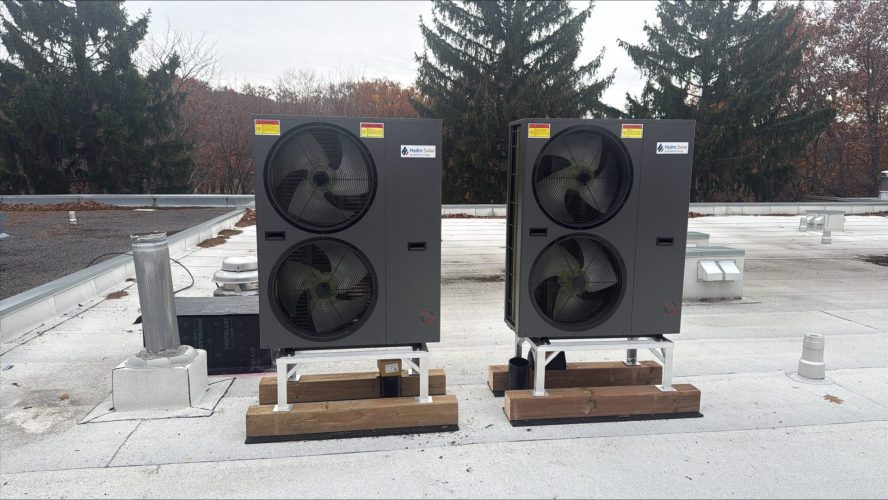



Several financial assistance programs can significantly reduce the cost of a commercial heat pump project in Québec.
Depending on the type of business and the project’s eligibility, Hydro-Québec’s Efficient Solutions Program can cover up to 90% of eligible costs for a small business and up to 75% for a medium or large business.
To take full advantage of them, grants must be considered from the project planning stage, before equipment is selected and work begins. Choosing a heat pump and then looking for financial assistance afterwards is not enough.
Caring for people and buildings — that is how BAULNE supports managers in analyzing their facilities, selecting eligible measures and planning a project suited to the technical and financial realities of their building.
With this in mind, our experts have gathered the questions our clients ask most often to guide you through every step of your commercial heat pump project.
1. What grants are available for a commercial heat pump?
Three programs in particular can be considered in Québec: Hydro-Québec’s Efficient Solutions Program, Énergir, and the Québec government’s ÉcoPerformance program.
Énergir’s Studies and Implementation program
Get $1 for every cubic metre of natural gas saved
Through Énergir’s program, receive financial assistance of $1 per m³ of natural gas saved during the first year after an energy efficiency measure is implemented. This financial support, which can reach up to $1,000,000 per customer account, is determined based on your business sector and the payback period.
Hydro-Québec’s Efficient Solutions Program
The Efficient Solutions Program for heat pumps provides financial support to businesses that install eligible equipment to improve the energy performance of their buildings.
For the purchase and installation of efficient heat pumps, financial support can cover:
- up to 90% of eligible costs for small businesses;
- up to 75% of eligible costs for medium and large businesses.
The actual amount depends on the project’s characteristics, the equipment selected, the estimated energy savings and the terms in effect at the time of the application.
Hydro-Québec also provides businesses with the OSE calculation tool (Efficient Solutions tool), which helps identify certain eligible measures and estimate potential financial support.
ÉcoPerformance program
The ÉcoPerformance program supports various energy efficiency, energy conversion and fossil-fuel greenhouse gas emission reduction projects.
Depending on the characteristics of the building and the project, a conversion to an electric solution or the implementation of measures that reduce fossil fuel consumption could be eligible.
An updated program framework came into effect on July 7, 2026. In addition, since September 1, 2026, no new applications are being accepted for recommissioning projects for building mechanical systems. It is therefore essential to check the applicable category before starting work.
2. How much could you get for your project?
There is no universal amount for a commercial heat pump. Financial assistance is influenced by factors such as:
- the size of the business;
- the type and use of the building;
- the existing heating equipment;
- the heat pump technology being considered;
- the eligible purchase and installation costs;
- the expected energy savings;
- the other measures included in the project;
- the program terms at the time of submission.
The financial analysis must take into account the project’s net cost after the grant, the expected energy savings and the useful life of the equipment.
A project that seems hard to justify based on its upfront cost alone can show a more attractive return once financial assistance, lower energy costs and avoided expenses are factored into the calculation.
3. What types of heat pumps and projects are eligible?
The Efficient Solutions Program offers opportunities for a range of technologies, including:
- air-source heat pumps;
- variable refrigerant flow (VRF) systems;
- geothermal heat pumps;
- certain split-system heat pumps;
- projects combining heat pumps with other eligible measures.
Technical requirements vary by technology. For example, since March 31, 2026, split air-source heat pumps must be ENERGY STAR® certified to be eligible for the Efficient Solutions Program.
The heat pump must also be selected based on the building’s actual needs. Its low-temperature capacity, coefficient of performance, heating load, operating conditions and backup system must all be assessed.
BAULNE experts’ tip
Before ordering equipment, confirm both its ability to meet the building’s needs and its eligibility for the available programs. System design, heat pump selection and the financing strategy should be carried out as part of a single process.
4. Can you get more by combining several measures?
Yes. A heat pump project can be an opportunity to analyze the energy performance of the building as a whole.
Since March 2026, the Efficient Solutions Program has offered a bonus for certain multi-measure projects that combine work in the following categories:
- heat recovery;
- geothermal heat pump;
- building envelope improvement.
Financial support can be increased by:
- 10% when two eligible measures are combined;
- 15% when three eligible measures are combined.
It is still worth evaluating other opportunities, such as optimizing control sequences and managing power demand, even if they do not necessarily qualify for this specific bonus.
An energy optimization approach makes it possible to compare measures based on their cost, potential savings, eligibility and return on investment.
5. Should you replace your current system with a heat pump?
A grant can improve a project’s profitability, but it should not be the only reason to replace equipment.
Before making a decision, you should assess, among other things:
- the age and condition of the existing system;
- the frequency and cost of repairs;
- parts availability;
- the type of refrigerant used;
- its actual performance;
- the building’s current and future needs;
- the available electrical capacity;
- expected performance during extreme cold;
- auxiliary or backup heating;
- potential savings and grants;
- the operational consequences of a breakdown.
Certain symptoms may warrant a more in-depth analysis:
- unstable temperature;
- near-continuous operation;
- very frequent start-stop cycles;
- unusual ice build-up;
- new noises or vibrations;
- an unexplained increase in consumption;
- recurring alarms;
- more frequent use of auxiliary heating;
- an increasing number of repairs.
These signs do not automatically mean the heat pump must be replaced. The problem may come from a control, a sensor, a filter, the airflow or a mechanical component.
Maintenance tips from our technicians to protect your investment
A well-maintained heat pump maintains its performance over time, reduces the risk of breakdowns and helps protect the value of your building. Here are the main recommendations from BAULNE’s technicians:
| Recommended action | Items to check | Objective |
|---|---|---|
| Have the system inspected before winter | Coils, fans, motors, filters and condensate drainage | Spot anomalies before extreme cold |
| Check defrost cycles | Sensors, controls, alarms and defrost sequences | Prevent ice build-up and maintain performance |
| Keep the outdoor unit clear | Snow, ice, debris and other obstructions | Ensure proper airflow |
| Test auxiliary or backup heating | Start-up, controls and backup capacity | Confirm it can effectively take over |
| Monitor operating data | Temperatures, operating hours, alarms and use of auxiliary heating | Quickly detect performance drift |
| Limit unauthorized adjustments | Thermostats, setpoints and mode changes | Avoid improper settings and overconsumption |
| Watch for unusual signs | New noises, vibrations and ice build-up | Identify possible mechanical deterioration |
| Document refrigerant-related work | Leaks, recovery, refrigerant top-ups and work performed | Facilitate regulatory follow-up and equipment planning |
A preventive HVAC maintenance strategy makes it possible to detect anomalies before they cause a heating outage. It also provides the data needed to decide whether it is better to repair, optimize or replace a heat pump.
This information becomes particularly useful when preparing a grant application. A well-documented maintenance history helps establish the condition of the equipment and justify the chosen modernization scenario.
To learn more about preparing your facilities, also consult BAULNE’s guide on building heating (available in French only).
6. Why carry out an energy analysis before investing?
An energy analysis identifies where the best savings opportunities really are. It helps avoid replacing equipment without first assessing the causes of consumption or the interactions with other systems.
This analysis can be used to:
- establish the building’s consumption profile;
- measure loads and peak periods;
- assess the performance of existing equipment;
- compare several modernization scenarios;
- identify heat recovery opportunities;
- analyze control sequences and building automation data;
- estimate savings, costs and return on investment;
- identify applicable financial assistance programs.
Financial assistance for an analysis varies depending on the program, the building’s consumption and the scope of the analysis. Eligibility must be confirmed before the study begins.
Once the project is selected, BAULNE’s design-build approach coordinates the analysis, design, equipment selection, installation, controls and commissioning.
7. How do you obtain a grant for your heat pump?
Ideally, a project should be planned before a major breakdown forces an urgent decision. Here is a 7-step table to help you obtain a grant for your heat pump:
| Step | Actions to take | Objective |
|---|---|---|
| 1. Assess existing facilities | Document the equipment’s age, condition, performance, maintenance history, repairs and operating costs | Get an accurate picture of the facilities |
| 2. Analyze the building’s needs | Assess heating loads, peak conditions, occupancy schedules, the distribution system and backup needs | Determine the building’s actual needs |
| 3. Compare scenarios | Analyze repair, optimization, conversion and replacement options | Compare total costs and impacts on operations |
| 4. Check applicable programs | Confirm eligibility criteria, covered measures, required documents and timelines | Avoid compromising the project’s eligibility |
| 5. Select the equipment | Choose a technology suited to the building and compliant with the program’s technical requirements | Ensure system performance and eligibility |
| 6. Prepare the application | Gather calculations, quotes, technical data sheets and other required documents before purchase or work, where required | Submit a complete application |
| 7. Carry out and document the project | Keep invoices, proof of installation, commissioning reports and required data | Facilitate final processing of the financial assistance application |
BAULNE’s multidisciplinary team, which includes engineers, refrigeration technicians, heating technicians and building automation technicians, can support managers at each of these steps.
In summary
Replacing a heating system should not start with choosing a heat pump. A preliminary analysis makes it possible to determine actual needs, compare solutions and check available grants before making a financial commitment.
With its expertise in HVAC services, energy efficiency and design-build, BAULNE can help you structure a high-performing, eligible project tailored to the realities of your building.
Schedule a visit from one of our experts at your facility.
Frequently asked questions about commercial heat pump grants
What grant is available for a commercial heat pump in Québec?
Hydro-Québec’s Efficient Solutions Program provides financial support for the purchase and installation of eligible heat pumps. Depending on the size of the business and the project’s characteristics, assistance can cover up to 90% of eligible costs for a small business and up to 75% for a medium or large business. Need help? Contact one of our experts.
Do you need to apply before starting work?
Requirements vary by program. Some steps and validations must be completed before purchasing equipment or starting work. It is therefore recommended to check the project’s eligibility and prepare the application before making a financial commitment. Our experts can help you with this first validation step.
Are all commercial heat pumps eligible?
No. Eligibility depends on the type of heat pump, its technical characteristics and the program requirements. For example, certain split air-source heat pumps must be ENERGY STAR® certified. The equipment must also be suited to the building’s loads and operating conditions.
Can a heat pump be combined with other measures?
Yes. Some multi-measure projects can receive a bonus when they combine a geothermal heat pump, heat recovery or building envelope improvements. An energy analysis identifies the most advantageous combinations. Need help? Contact one of our experts.
Can BAULNE support managers with their application?
BAULNE can support owners and managers in analyzing facilities, comparing scenarios, selecting equipment and identifying applicable programs. This support makes it possible to integrate technical and financial criteria from the project planning stage.
About BAULNE
BAULNE — A local company and a leader in building mechanical systems.
For nearly 25 years, BAULNE has been simplifying HVAC management for business clients through intelligent solutions that reduce operating costs while improving comfort and productivity.
Our motto: Caring for people and buildings.
Learn more →
Discover more insights in our articles section.