
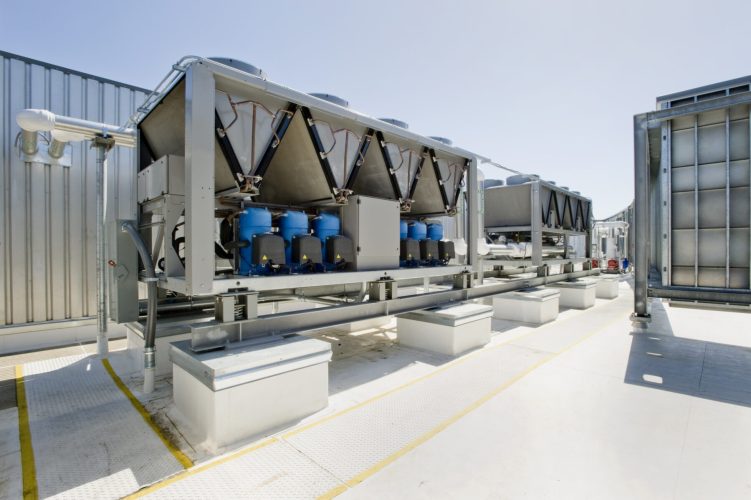



What building owners and facility managers need to know
Updated: June 2026 | By the BAULNE Technical Team | Estimated reading time: 6 min
If your building was constructed or renovated between 1995 and 2015, there is a strong chance your cooling equipment is still running on R22 refrigerant (HCFC-22). You are not alone. Hundreds of building managers, maintenance directors, and property owners in Québec are facing the same reality today.
The question is no longer whether action will be needed, but when and how.
This guide presents the concrete issues, the three available options, and the criteria for making the best decision for your building — with no unpleasant surprises.
Why R22 Is Still a Critical Issue in 2026
R22 refrigerant — also known as HCFC-22 — was for decades the standard refrigerant in the commercial and industrial HVAC industry. Its production and importation are now prohibited as part of the phased elimination of ozone-depleting substances.
Yet many systems continue to operate. And that is where the problem begins:
| Availability | Only recycled R22 is available. Stocks decrease every year and supply lead times are growing longer. |
| Rising costs | The price of recycled R22 has surged in recent years. A recharge can represent several thousands of dollars. |
| Aging equipment | An R22 system is generally 15 to 30 years old. The frequency of breakdowns increases and replacement parts are becoming scarce. |
| Outdated efficiency | Modern equipment consumes 20% to 40% less energy — a significant difference on your annual energy bill. |
How to Know If Your System Runs on R22?
Here are the most reliable indicators:
- The equipment dates from approximately 1995 to 2015
- The nameplate indicates HCFC-22 or R22
- The system has required refrigerant recharges in recent years
- Maintenance costs increase year over year without a clear mechanical reason
If in doubt, a technical inspection by a certified refrigeration technician can confirm the type of refrigerant used and the overall condition of the system.
The 3 Available Options — And When Each Applies
Option 1: Continue With the Existing Equipment
This approach involves keeping the system operational as long as possible by performing required repairs and recharging with recycled R22 when necessary.
When it is relevant:
- The system is in good overall condition and recently maintained
- Building use is limited or seasonal
- No major renovation is planned in the short term
- Investment budget is not immediately available
Risks to evaluate:
- Recycled R22 costs are rising and availability is uncertain
- In the event of a significant leak, the repair can be prohibitively expensive
- Temporary strategy: it only delays the inevitable
Our view: “This option is acceptable in the short term if the equipment is well maintained and the replacement decision is planned within a 2 to 4 year horizon.”
Option 2: Convert the System (Retrofit)
Conversion involves adapting the existing equipment to operate with a substitute refrigerant — generally an HFC such as R407C, R410A, or an equivalent blend.
What conversion involves:
- Replacement of lubricating oil
- Verification and adjustment of components (expansion valve, pressure switches)
- Compatibility testing of seals and materials
- Update of control parameters
When it is a good option:
- For small to medium capacity commercial air conditioning units
- For low-capacity chillers whose mechanical structure is in good condition
- When a complete replacement is not economically justifiable in the short term
⚠️ Critical Limitation — Large Capacity Chillers
The industry has still not identified a refrigerant capable of adequately replacing R22 in large capacity chillers. For this equipment, only two options exist:
- Repair with recycled R22 (costly, temporary, limited supply)
- Complete unit replacement (viable long-term solution)
A large capacity R22 chiller must be planned for replacement.
Option 3: Replace the Equipment
Complete replacement is often the most strategic solution in the medium and long term, particularly for large capacity chillers and systems that are accumulating breakdowns.
Concrete advantages:
- Complete elimination of R22 dependency
- Reduction in energy consumption (20% to 40% depending on equipment)
- Modern refrigerants with low environmental impact
- Intelligent control systems compatible with building automation systems
- Manufacturer warranty and parts access for 15 to 20 years
- Significant reduction in the risk of unexpected breakdowns
When replacement becomes the wisest decision:
- The equipment is 15 to 25 years old or more
- Repairs are increasingly frequent and costly
- The coefficient of performance (COP) is well below current standards
- A major breakdown would cause an unacceptable operational interruption
- An asset maintenance program is being planned
Return on investment — In many cases, energy savings achieved over 5 to 10 years offset a significant portion of the initial investment — especially when energy efficiency subsidy programs (Hydro-Québec, Transition énergétique Québec) are leveraged.
Proactive Planning: Why It Changes Everything
The difference between a planned replacement and an emergency replacement can represent tens of thousands of dollars — and weeks of operational downtime.
A chiller that breaks down in the middle of summer, given current delivery lead times, can mean several weeks without air conditioning. For an institution, a commercial building, or a production facility, the consequences are major.
Proactive planning allows you to:
- Compare equipment and manufacturers without pressure
- Negotiate purchase and installation terms
- Spread the investment according to budget cycles
- Take advantage of available subsidy programs
- Coordinate work without impacting operations
FAQ — Frequently Asked Questions About R22
Is R22 still legal in Canada?
Using R22 in existing equipment is still permitted. However, the production and importation of new R22 are prohibited. Only recycled or recovered R22 can be used for the maintenance of existing systems.
Can I continue to have an R22 system serviced?
Yes, as long as recycled R22 is available on the market and maintenance is performed by a certified refrigeration technician. However, availability is decreasing and costs increase every year.
What refrigerant can replace R22?
For small systems, refrigerants such as R407C or R422D can be used in a retrofit. For large capacity chillers, no substitute refrigerant has been validated by the industry — complete replacement is generally the only viable option.
Are there subsidies for replacing HVAC equipment in Québec?
Yes. Hydro-Québec and Transition énergétique Québec offer energy efficiency support programs for commercial and industrial buildings. Our team can guide you through the process.
How to plan the transition optimally?
The recommended approach: (1) have the current condition of the equipment assessed, (2) document maintenance costs over the past 3 to 5 years, (3) compare scenarios over a 10-year horizon, then (4) plan the transition before a breakdown forces a hasty decision.
Download the Complete Ebook
Our ebook 2026 Guide – R22 HVAC Systems provides a comprehensive analysis: implications by equipment type, available replacement refrigerants, economic criteria, and a planning guide for building managers.
About BAULNE
BAULNE – A local company, leader in building mechanics.
For over 20 years, BAULNE has been simplifying HVAC management for business clients through intelligent solutions that reduce operating costs while improving comfort and productivity.
Our motto:Caring for people and buildings
Learn more →
Discover more analyses in our Articles Section.