
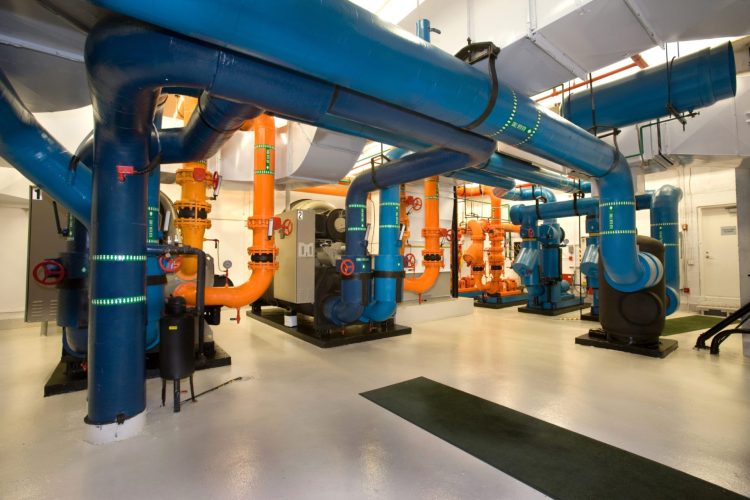



What building managers and owners must know
Updated: June 2026 | By the BAULNE team — HVAC Experts since 2002
Building mechanics encompasses all the technical systems that ensure the comfort, safety, and energy efficiency of a commercial, industrial, or institutional building. HVAC (heating, ventilation, and air conditioning), plumbing, refrigeration, automation — these are all disciplines that today’s manager must understand in order to make better decisions and reduce operating costs.
This complete guide is designed for building managers, maintenance directors, production directors, and owners who want to understand their equipment, anticipate breakdowns, and optimize the performance of their buildings in Québec.
What you’ll learn in this guide:
- The definition and role of building mechanics
- The 5 pillars of HVAC systems
- Key equipment and its functions
- Automation and smart buildings
- Energy efficiency in Québec (standards, subsidies, certifications)
- Preventive maintenance best practices
- How to choose a building mechanics contractor
Why is building mechanics a strategic issue?
Building mechanics is no longer simply a matter of comfort or maintenance. For property managers, operations directors, and building owners, it has become a strategic lever that directly influences operating costs, asset performance, and building sustainability.
According to Natural Resources Canada, space heating alone accounts for about 55% of the energy consumed in commercial and institutional buildings. This makes HVAC systems one of the main expense items — and one of the greatest savings opportunities — in a building.
At the same time, managers must contend with new challenges that make infrastructure management more complex:
- Rising energy costs, increasing pressure on operating budgets;
- Aging HVAC equipment, requiring significant investment in asset renewal;
- Shortage of skilled labour, lengthening response and replacement times;
- Greenhouse gas (GHG) emission reductions and building decarbonization targets;
- Growing ESG and regulatory requirements from investors and occupants;
- Parts and equipment availability, sometimes affected by global supply chains;
- Transition to new low global warming potential (GWP) refrigerants, forcing many organizations to plan the replacement of certain equipment.
In this context, a proactive approach to building mechanics not only reduces energy costs but also improves the reliability of installations, occupant comfort, equipment lifespan, and the overall value of the building. This is why the highest-performing organizations are now investing in preventive maintenance, building automation, energy optimization, and long-term asset planning to turn their building mechanics into a genuine competitive advantage.
What is building mechanics?
Building mechanics refers to all the mechanical systems that ensure a building operates properly. It includes:
- Heating — heat production and distribution
- Ventilation — air circulation and filtration
- Air conditioning — cooling and humidity control
- Industrial and commercial refrigeration
- Industrial plumbing — pumps, piping, tanks
- Building automation (smart building)
In Québec, buildings must cope with extreme temperatures: from -30°C in winter to +35°C in summer. This climate reality makes building mechanics both essential and demanding. A poorly sized or poorly maintained system directly results in higher energy costs, production shutdowns, and occupant discomfort.
According to the Canada Green Building Council, residential, commercial, and institutional buildings are responsible for 18% of GHG emissions in Canada — nearly 30% when construction materials are included.
According to the Canada Energy Regulator, the buildings sector accounts for 87 megatonnes of GHG emissions, and emissions from this sector have risen 2% since 2005, unlike other sectors where emissions are declining.
| Sector | Emissions (Mt) | % of Canada total (653 Mt) |
|---|---|---|
| Oil and gas | 189 Mt | ~29% |
| Transportation | 150 Mt | ~23% |
| Buildings (residential + commercial) | 87 Mt | ~13% |
| Heavy industry | 77 Mt | ~12% |
| Agriculture | 69 Mt | ~11% |
| Electricity | 52 Mt | ~8% |
Based on these statistics, it is clear that optimizing HVAC systems is both an economic and an environmental priority. It is in this context that building mechanics must evolve and adapt.
What is the difference between building mechanics and HVAC?
Building mechanics is a broader term that includes HVAC systems but also encompasses other equipment such as plumbing, building automation controls, and specialized systems such as natural gas detectors.
Concrete example
In a commercial building in Montréal:
- Replacing a rooftop unit or servicing a heat pump = HVAC.
- Fully designing the mechanical room, including heating, ventilation, plumbing, sprinklers, and building automation = building mechanics.
Quick summary
| Term | What it includes |
|---|---|
| HVAC | Heating, ventilation, air conditioning, and refrigeration |
| Building mechanics | HVAC + plumbing + fire protection + building automation + other mechanical systems |
For a property manager or operations director, HVAC is often the most visible component of building mechanics, since it can account for up to 40 to 60% of a commercial building’s energy consumption depending on its use and age. This is why companies like BAULNE often speak of building mechanics when offering a comprehensive approach, but of HVAC when intervening on comfort and energy-efficiency systems.
“According to Natural Resources Canada, space heating alone accounts for about 55% of the energy consumed in commercial and institutional buildings. This explains why optimizing HVAC systems is often one of the most cost-effective levers for reducing operating costs and improving a building’s energy performance.”
Building mechanics glossary
| HVAC | Heating, ventilation, and air conditioning. |
| BMS (Building Management System) | A centralized system used to control and monitor a building’s equipment. |
| GTB (French acronym for Building Technical Management) | The French-language equivalent of BMS. |
| Building automation | The automation and intelligent control of a building’s systems. |
| Heat pump | Equipment used to heat and cool a building. |
| Rooftop unit | An HVAC system installed on the roof of a commercial building. |
| Cooling tower | Equipment used to reject heat from cooling systems. |
| Boiler | Equipment that produces hot water or steam for heating. |
| Recommissioning | A process aimed at optimizing the performance of existing systems. |
| EUI | A building’s energy use intensity index. |
The 5 pillars of building mechanics
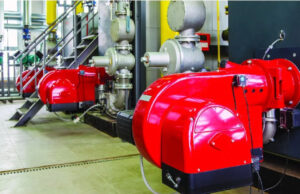
Commercial and industrial heating
Heating accounts for the largest share of energy consumption in Québec buildings. The main types of equipment are:
- Boilers powered by natural gas or electricity — hot water or steam production
- Unit heaters — targeted zone heating by forced convection
- Radiant heaters — infrared radiant heating, ideal for warehouses and open spaces
- Rooftop units with heating mode — versatile, freeing up interior space
Expert tip: Boilers are pressurized equipment regulated by the Régie du bâtiment du Québec (RBQ). Annual maintenance is mandatory and must be performed by a certified professional.
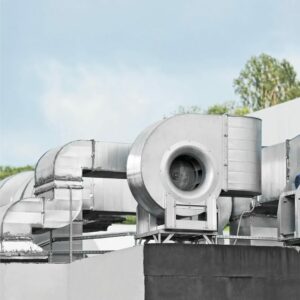
Ventilation and indoor air quality (IAQ)
An effective ventilation system is the “lungs” of your building. It ensures:
- The intake of fresh outdoor air (air make-up units)
- Filtration of particles, pollen, and contaminants
- Evacuation of stale air, gases, and odours
- Heat recovery from exhaust air (heat exchangers)
ASHRAE 62.1 standards define minimum ventilation flow rates for commercial spaces. Failure to meet these standards can lead to health issues for occupants (sick building syndrome) and regulatory fines.
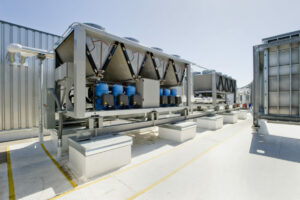
Air conditioning and cooling
Commercial and industrial air conditioning includes several technologies depending on the building’s size and needs:
| Equipment | Typical capacity | Application |
|---|---|---|
| Rooftop unit | 5 to 150 tons | Commercial, light industrial |
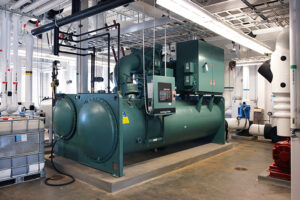
| Water-cooled chiller | 50 to 2,000 tons | Large buildings, industrial process |
| Air-cooled chiller | 5 to 200 tons | Commercial, mid-size installations |
| Cooling tower | 50 to 5,000 tons | Paired with water-cooled chillers |
| Heat exchanger | Variable | Energy recovery, process |
Mechanical systems — pumps and distribution
Industrial and commercial pumps circulate fluids throughout the building: hot water, chilled water, cooling water. There are two main families:
- Centrifugal pumps: the most common — radial, mixed, or axial flow depending on the required pressure
- Positive displacement pumps: for applications requiring precise, stable flow
Proper sizing and maintenance of pumps are critical: an undersized pump creates pressure problems, while an oversized pump wastes energy and wears out prematurely.

Automation and building intelligence (Smart Building)
Building automation — or building intelligence — is transforming the way HVAC systems are managed. A Building Automation System (BAS) enables:
- Centralized supervision of all equipment from a single interface
- Scheduled programming and equipment modulation based on occupancy
- Early detection of anomalies and real-time alerts
- Data collection to optimize performance and reduce costs
- Integration with fire safety, access control, and security systems
By 2026, leading-edge systems integrate artificial intelligence to predict failures before they occur (predictive maintenance), optimize energy consumption in real time, and adapt to changing weather conditions.
HVAC equipment in detail
Rooftop Units
Rooftop units are among the most versatile pieces of equipment in building mechanics. Installed on the roof, they maximize interior space and can simultaneously provide heating, ventilation, and air conditioning.
Key advantages:
- Decentralized design: a breakdown doesn’t affect the entire building
- Easier maintenance: roof access without disrupting occupants
- Can be integrated with building automation systems for remote control
- Wide range: from a few tons up to more than 100 tons of refrigeration
Boilers
Boilers produce the hot water or steam needed for heating and certain industrial processes. As pressurized equipment, they are subject to strict regulation in Québec.
Points to watch:
- Mandatory annual inspection under the Pressure Vessels Act (RBQ)
- Regular blowdown to prevent scale and sediment buildup
- Combustion parameter control to optimize efficiency and reduce emissions
- Planned replacement: an end-of-life boiler costs more in repairs than in replacement
Industrial and commercial fans
Industrial fans fall into two main families based on airflow direction:
- Centrifugal fans: ideal for duct networks with high pressure losses
- Axial fans: suited to high airflow volumes with low resistance
The choice of fan depends on the required airflow (m³/h), the network’s static pressure, acceptable noise level, and target energy efficiency.
Air Make-Up Units
Air make-up units (AMUs) bring fresh outdoor air into the building to replace air removed by exhaust systems. They are essential in commercial kitchens, high-occupancy spaces, and industrial areas with pollutant extraction.
A properly sized AMU maintains slight positive pressure in the building, which prevents cold-air infiltration in winter and reduces heating costs.
Cooling towers
A cooling tower rejects heat from a process or HVAC system into the atmosphere through evaporation. It is paired with water-cooled chillers in large buildings.
Critical maintenance:
- Water treatment: prevention of scale, corrosion, and Legionella
- Seasonal cleaning of basins and fill media
- Inspection of fans, belts, and bearings
- Compliance with the Regulation respecting the quality of pool and cooling tower water (Public Health Act, Québec)
Chillers
Chillers produce chilled water (typically between 6 and 12°C), which is then distributed throughout the building to provide cooling. There are two main types:
- Mechanical compression chillers (screw, centrifugal, scroll) — the most common
- Absorption chillers — use heat rather than electricity, ideal for recovering industrial heat
The COP (coefficient of performance) of a modern chiller ranges between 4 and 7, meaning it produces 4 to 7 kW of cooling for every kW of electricity consumed.
Heat exchangers
A heat exchanger transfers thermal energy between two fluids without mixing them. It is central to many applications:
- Preheating ventilation air with exhaust air (heating savings)
- Heat recovery from industrial effluents
- Process heating or cooling
Several types exist: plate exchangers (compact, efficient), shell-and-tube exchangers (rugged, for high pressures), spiral and coil exchangers.
Industrial and commercial pumps
Pumps circulate heat-transfer fluids throughout the building. Proper selection ensures system efficiency and equipment longevity. The key parameters are flow rate (L/s or GPM), total dynamic head (TDH), and available NPSH.
Leading brands in building mechanics

Heating and air conditioning
- Bousquet
- Carrier
- Daikin
- Lennox
- Trane
- York
Automation and controls
- Alerton
- Delta Controls
- Honeywell
- Johnson Controls
- Schneider Electric
- Siemens
This is a short selection; however, our experts have compiled a complete list of HVAC systems brands, including their detailed descriptions and advantages.
This was a summary of the equipment. For more details, we invite you to read our article on building mechanics equipment.
Leading associations in building mechanics in Québec
| AQME | An organization dedicated to energy efficiency. |
| ASHRAE | The global reference for HVAC and energy-efficiency standards. Official website ASHRAE. Want to learn more about the standards? Read our article: ASHRAE Standards — What to Know |
| BOMA Québec | An association representing property owners and managers. |
| LEED Certification | LEED (Leadership in Energy and Environmental Design) certification. LEED official website. Want to learn more about the certification? Read our article on the LEED v5 certification. |
| CETAF | The Corporation des entreprises de traitement de l’air et du froid. CETAF official website. Learn more about the refrigeration technician trade and CETAF’s support (in French). |
| CMMTQ | An association representing contractors specialized in plumbing and heating. |
| CQ3E | Conseil québécois des entreprises en efficacité énergétique (CQ3E). |
| Régie du bâtiment du Québec | The body responsible for building regulation in Québec. |
Energy efficiency and sustainable development in Québec
Energy efficiency in buildings is at the heart of today’s challenges. In Québec, several levers make it possible to reduce energy consumption while complying with current regulations.
Applicable standards and regulations
- National Energy Code for Buildings (NECB) — efficiency of envelopes and HVAC systems
- ASHRAE 90.1 Standards — international benchmark for commercial building energy efficiency
- ASHRAE 55 — thermal comfort standards for occupants
- Québec’s Energy Efficiency Regulation (EER)
- Environment Quality Act (EQA) for combustion equipment emissions
Available certifications
- LEED (Leadership in Energy and Environmental Design) — a North American certification recognized worldwide
- BOMA BEST — a Canadian program for existing buildings focused on sustainable management and operations
Subsidy programs available in Québec (2026)
Available funding programs
- Hydro-Québec — Energy Efficiency Program for Businesses: subsidies for high-efficiency HVAC equipment, energy management systems, and heat recovery. Learn more.
- Énergir. Financial assistance of $0.30 to $1 per m³ of natural gas saved during the year the measures are implemented, up to a maximum cap of $1,000,000. Learn more.
- ÉcoPerformance Program. This program offers financial assistance covering up to 75% of energy analysis costs, with a cap of $100,000 per site for small and medium consumers, and up to $300,000 for large consumers. Learn more.
Energy efficiency subsidies: a lever to accelerate your return on investment
Energy efficiency projects not only reduce a building’s operating costs but can also provide access to various subsidy programs. In Québec, several government initiatives and financial assistance programs support businesses investing in optimizing their HVAC systems, building automation, heat recovery, or equipment modernization.
These programs can significantly reduce implementation costs and improve the profitability of energy projects. However, identifying eligible programs, preparing applications, and following up on requests can be a challenge for property managers and operations directors.
The BAULNE team supports its clients in identifying funding opportunities in order to maximize savings and accelerate the return on investment of their modernization projects.
Want to know which subsidies could apply to your building or energy optimization project?
Consult our complete guide on the available programs as well as the energy subsidies currently available.
Our experts can also help you analyze your eligibility and prepare your subsidy application. Schedule a visit from a BAULNE expert to your facility.
Key technologies for reducing energy consumption
- Variable frequency drives (VFDs) on fan and pump motors — savings of 30 to 50%
- Heat recovery from exhaust air — heating needs reduced by up to 70%
- Building Management System (BMS) — real-time optimization of all equipment
- LED lighting and occupancy-based lighting control
- Building envelope — insulation, fenestration, and air tightness
- Transition to low-GWP (global warming potential) refrigerants — R-32, R-454B, CO2
Important note for 2026: The refrigerant transition is underway. High-GWP HFCs (R-410A, R-22) are being progressively replaced by lower-impact alternatives, in line with commitments under the Kigali Amendment. Plan for the impact on your existing equipment in your upcoming tenders. Read our free R22 replacement guide
Preventive maintenance and asset management plan
Preventive maintenance is the most cost-effective investment in building mechanics. It helps avoid costly breakdowns, extend equipment lifespan, and maintain optimal performance.
Recommended maintenance frequencies
| Equipment | Monthly | Semi-annual | Annual |
|---|---|---|---|
| Rooftop units | Filters, belts | Coil cleaning | Complete inspection |
| Boilers | Parameter check | Blowdown, combustion check | Mandatory RBQ inspection |
| Cooling towers | Water quality, treatment | Basin cleaning | Mechanical inspection |
| Chillers | Refrigerant leak check | Oil analysis, vibration | Complete inspection |
| Pumps | Pressure, noise check | Seals, bearings | Hydraulic balancing |
| Fans | Filters | Belt alignment | Wheel cleaning |
Asset Management Plan (AMP)
An Asset Management Plan is a strategic tool that catalogues all equipment, its current condition, remaining useful life, and the investments to plan over a 5- to 20-year horizon.
Benefits of an AMP:
- Budget planning — eliminate surprises and smooth expenses over time
- Replacement prioritization — intervene at the right time, neither too early nor too late
- Reduced operating costs — end-of-life equipment consumes more energy
- Documentation for insurers and potential buyers
- Regulatory compliance — tracking of legal inspection obligations
Average lifespan of HVAC equipment
- Rooftop units: 15 to 20 years
- Boilers: 20 to 30 years
- Chillers: 20 to 25 years
- Cooling towers: 15 to 20 years
- Pumps: 15 to 25 years
- Industrial fans: 20 to 30 years
- Building Management System (BMS): 15 to 20 years
Note: These lifespans vary depending on the quality of maintenance performed.
Predictive maintenance — the new frontier
Predictive maintenance uses sensors, data analysis, and artificial intelligence to predict a failure before it occurs. Unlike corrective maintenance (repairing after a breakdown) or preventive maintenance (servicing at fixed intervals), predictive maintenance intervenes at the optimal moment.
In practice, sensors continuously measure vibration, temperature, electrical consumption, and other parameters. Machine-learning algorithms detect subtle anomalies that precede a failure, allowing intervention before a shutdown occurs.
Choosing a building mechanics contractor in Québec
The choice of a building mechanics contractor (in French) is a strategic decision that commits your building for years to come. Here are the key criteria to evaluate.
Required qualifications and licences
- Régie du bâtiment du Québec (RBQ) licence — mandatory for any building mechanics contractor
- Relevant licence sub-categories: 16.1 (piping), 16.2 (refrigeration), 16.3 (ventilation), 16.4 (heating), 16.5 (air conditioning)
- Liability insurance and bonding
- Refrigeration technician certification — recognized training program
Evaluation criteria
| Criterion | Questions to ask |
|---|---|
| Experience | How many years have you been in business? Do you have references in my industry? |
| Technical capacity | What equipment do you specialize in? Do you have in-house engineers? |
| Responsiveness | What is your response time for emergencies? Do you offer 24/7 service? |
| Geographic coverage | Do you operate in my region? Do you have multiple crews? |
| Maintenance plan | Do you offer annual service contracts? What tracking tools do you use? |
| Energy approach | Do you perform energy audits? Are you familiar with subsidy programs? |
The benefits of an integrated partner
A contractor offering a full range of services — design-build, maintenance, energy optimization — offers several advantages over managing multiple subcontractors:
- Single point of accountability and simplified contract management
- In-depth knowledge of your equipment and building history
- Continuity of interventions and consistency of proposed solutions
- Potential savings through bundled equipment negotiation
- A single point of contact when a problem involves multiple systems
Building mechanics trends in 2026–2027 (Summary)
The building mechanics sector is rapidly evolving toward higher performance, driven by six major pillars:
1. Artificial intelligence becomes a decision-support tool
AI now makes it possible to analyze thousands of data points from HVAC equipment to detect anomalies, anticipate failures, and optimize energy consumption. That said, the technology remains a support tool: the expertise of technicians and managers remains essential to interpret results and make the right decisions.
Discover how AI is concretely transforming smart building management in our article.
2. Predictive maintenance reduces unplanned downtime
Thanks to connected sensors and machine-learning algorithms, it is now possible to identify the early warning signs of a breakdown before it happens. This approach reduces business interruptions, improves equipment reliability, and allows for better maintenance planning.
Read our full article on smart building trends
Learn more about preventive maintenance strategies
3. Building automation becomes the backbone of smart buildings
Building automation systems centralize the management of HVAC equipment, alarms, and performance data on a single platform. Managers can thus monitor multiple sites, receive real-time alerts, and make decisions faster.
Discover how smart technologies are transforming commercial buildings
4. Real-time data speeds up interventions
Instant access to operational data considerably improves the speed and accuracy of diagnostics. Maintenance teams have reliable information before they even arrive on site, reducing response times and associated costs.
To maximize the value of this data, many organizations are also investing in the continuous optimization of their HVAC systems
5. The human factor remains at the heart of performance
Despite the rapid evolution of technology, field experience remains irreplaceable. Algorithms can flag a problem, but only qualified experts can validate a diagnosis, understand the operating context, and recommend the most relevant actions.
Discover the perspective of BAULNE’s experts in the full article: Smart Building Trends.
6. Smart buildings become a lever for operational performance
Beyond energy savings, new technologies improve occupant comfort, equipment reliability, multi-site management, and compliance with new regulatory requirements. Smart buildings are no longer a trend — they are becoming a competitive advantage.
For organizations planning a major modernization or improvement project, the design-build approach makes it possible to integrate these technologies right from the design stage: https://www.baulne.ca/en/design-build/
Want to better understand how artificial intelligence, building automation, and predictive maintenance can improve the performance of your buildings?
Discover our experts’ full analysis in the article 2026 Trends for a Smart Building: Between Artificial Intelligence and Human Expertise: https://www.baulne.ca/en/articles-hvac/smart-building-trends-2026/
Conclusion: building mechanics as a strategic advantage
Understanding building mechanics is not just a technical matter — it is a strategic advantage for any manager or owner of a commercial or industrial building in Québec. Well-chosen, properly sized, and rigorously maintained equipment can:
- Reduce energy costs by 20 to 40% through efficiency and automation
- Extend equipment lifespan by 5 to 10 years through preventive maintenance
- Ensure occupant comfort and health, which directly influences productivity
- Comply with current regulations and avoid fines and liabilities
- Increase the value of your real estate asset during transactions or refinancing
Need a building mechanics expert?
The BAULNE team has supported managers and owners of commercial and industrial buildings since 2002. Maintenance, design-build, energy optimization — our RBQ-certified experts work throughout Québec. Montréal area: 514 422-0444. Québec City area: 418 476-0444. www.baulne.ca
FAQ — Frequently asked questions about building mechanics
What is the difference between HVAC and building mechanics?
The term HVAC (heating, ventilation, air conditioning) refers specifically to thermal and ventilation systems. Building mechanics is a broader term that encompasses HVAC, but also industrial plumbing, refrigeration, pumps, and building automation.
How often should HVAC equipment be serviced?
Frequency depends on the type of equipment and its use. As a general rule, semi-annual maintenance (spring and fall) is recommended for most equipment, with monthly checks for critical components such as filters and cooling tower water quality. Boilers require a mandatory annual inspection under Québec regulations.
What certifications must an HVAC contractor hold in Québec?
In Québec, any building mechanics contractor must hold a licence from the Régie du bâtiment du Québec (RBQ) in the sub-categories corresponding to the work performed (piping, refrigeration, ventilation, heating, air conditioning). Refrigeration technicians must also be certified.
How can I reduce my HVAC-related energy costs?
The main savings levers are: installing variable frequency drives (VFDs) on motors, recovering heat from exhaust air, optimizing the Building Management System (BMS), replacing aging equipment with high-efficiency models, and taking advantage of available subsidy programs (Hydro-Québec, ÉcoPerformance).
What is an Asset Management Plan (AMP) and do I need one?
An AMP is a multi-year plan that catalogues all your equipment, assesses its condition, and plans replacement investments. It is strongly recommended for any building larger than 5,000 m² or more than 15 years old. It helps smooth expenses over time, avoid costly breakdowns, and plan the operating budget with precision.
Related articles
- Complete guide to rooftop units
- Everything you need to know about cooling towers
- Heat exchangers: types and applications
- Industrial and commercial pumps
- Building automation and smart buildings
- Energy efficiency subsidy programs
- LEED certification: benefits and process
About BAULNE
BAULNE — A local company, leader in building mechanics.
For over 20 years, BAULNE has been simplifying HVAC management for business clients through intelligent solutions that reduce operating costs while improving comfort and productivity.
Our motto: Caring for people and buildings.
Learn more →
Discover more insights in our Articles Section.